Building Confidence and Professional Networks Through Speaking at Medical Meetings
Headline
From Audience Member to Conference Speaker: Building Confidence Through Professional Engagement
1-minute summary
In this expert contribution, ophthalmologist Jennifer Loh, MD, describes how participating in professional meetings evolved from an opportunity to learn and connect with colleagues into a pathway toward becoming a conference speaker.
Her experience began shortly after residency, when attending an American Society of Cataract and Refractive Surgery (ASCRS) meeting exposed her to new lectures, technologies and clinical perspectives. The experience also highlighted how rapidly ophthalmic technology changes and reinforced the need for continued learning after formal training.
After moving from residency into a small private practice, Loh missed the collegial environment she had experienced during training. Attending meetings provided an opportunity to rebuild those professional relationships, meet peers and develop a support network.
Her eventual transition from attendee to speaker began with an invitation to give a lecture. Subsequent speaking opportunities followed, allowing her to teach while simultaneously learning from the process.
She emphasizes that clinicians who are nervous about public speaking can start with relatively small steps, such as asking questions during sessions, participating in panels or speaking directly with lecturers after presentations.
Her central message is that professional speaking can provide benefits beyond presentation skills, including confidence, mentorship, friendship, networking, clinical reflection and continued professional development.
Why this matters
Medical conferences are not only venues for presenting research and learning about new developments. They can also help clinicians build relationships with peers, mentors and professional collaborators.
Loh’s account highlights several potential benefits of becoming actively involved in professional meetings:
-
Exposure to new clinical information and technologies
-
Interaction with peers from different practices and institutions
-
Development of professional confidence
-
Opportunities for mentorship
-
Development of a long-term professional network
-
Opportunities to teach and exchange clinical experiences
-
Reflection on one’s own clinical practice
-
Development of public-speaking skills
Her experience also illustrates that professional involvement does not necessarily begin with a major speaking role. Smaller forms of participation can serve as an entry point.
Study at a glance
Because the article is an expert submission describing an individual’s professional experience, conventional clinical-trial fields are not applicable.
| Feature | Details |
|---|---|
| Article type | Expert submission / professional experience |
| Author | Jennifer Loh, MD |
| Field | Ophthalmology |
| Topic | Speaking at professional medical meetings |
| Clinical trial | Not applicable |
| Participants | Not a research participant cohort |
| Intervention | Not applicable |
| Comparator | Not applicable |
| Primary outcome | Not applicable |
| Follow-up | Not applicable |
| Evidence type | Personal experience and professional opinion |
| Financial disclosures | No products or companies requiring disclosure were reported |
From residency to professional meetings
Loh describes attending her first ASCRS meeting soon after completing residency.
She was impressed by the quality of the educational sessions and recognized that completing residency did not mark the end of learning.
Instead, the experience demonstrated that ophthalmology continues to evolve rapidly, particularly with advances in technology.
Her experience can be summarized as:
Residency → conference attendance → continued learning → professional relationships → speaking opportunities
The importance of professional community
After residency, Loh moved into a small private practice with only one other physician.
Although she describes her colleague positively, the environment differed from the collegial atmosphere she had experienced during residency.
She missed the informal interaction and sense of community that came from working alongside a larger group of colleagues.
This motivated her to attend more professional meetings.
The meetings served two purposes:
-
Education: learning about new developments and clinical approaches.
-
Networking: developing relationships with other physicians.
Over time, these interactions evolved into a professional support network.
From attendee to speaker
Loh’s transition into speaking was gradual.
After attending meetings primarily as a learner and participant, she eventually received an invitation to speak.
That initial lecture subsequently led to additional speaking opportunities.
She describes the process as cumulative: one opportunity created another, allowing her to become increasingly involved in professional education.
She also emphasizes that speaking benefited her own learning.
Preparing a presentation requires a physician to:
-
review relevant literature,
-
examine clinical cases,
-
consider new research,
-
organize information,
-
evaluate personal experience, and
-
communicate conclusions clearly.
This process can therefore encourage clinicians to critically examine their own clinical practice.
Building confidence gradually
Loh describes public speaking as something that initially required considerable confidence-building.
Even asking a question during a conference session could feel intimidating.
She recalls:
“My heart would pound.”
Rather than viewing nervousness as a reason to avoid participation, she suggests using small opportunities to gradually become more comfortable.
Examples include:
| Starting point | Potential benefit |
|---|---|
| Asking a question from the audience | Builds confidence speaking publicly |
| Helping with a panel | Provides structured speaking experience |
| Talking with lecturers after sessions | Builds professional relationships |
| Participating in meetings | Increases familiarity with the professional environment |
| Giving presentations | Develops formal speaking skills |
Her message is that clinicians do not necessarily need to begin with a major lecture.
Instead:
“Get involved. Ask a question. Help out on a panel. Talk to the lecturers after they speak.”
A supportive environment
Loh acknowledges that speaking before an audience can be stressful, particularly for someone early in their career.
However, she argues that speakers should recognize that colleagues and conference audiences generally want them to succeed.
She advises early-career physicians to:
-
begin with manageable opportunities,
-
recognize that nervousness is common,
-
become involved rather than remaining passive,
-
seek opportunities to contribute, and
-
recognize that their perspectives have value.
She summarizes this encouragement with the advice:
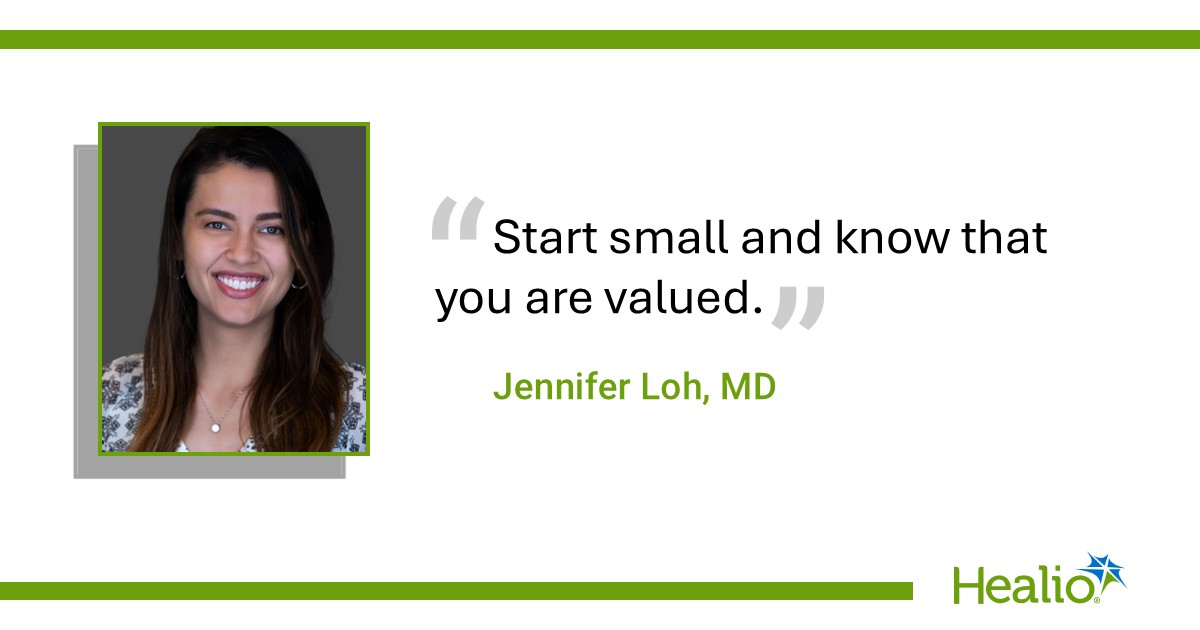
“Start small and know that you are valued.”
What the speaker gains
According to Loh, speaking at meetings provides benefits beyond the opportunity to teach.
One important benefit is the ability to meet peers and mentors.
Over time, these relationships can become a practical professional resource.
She describes developing:
“a huge network of colleagues, friends and advisors”
to whom she can turn when she has questions.
This illustrates the difference between simply attending a conference and becoming actively involved in its professional community.
Professional networking as a long-term resource
The relationships developed through conferences can extend well beyond the meeting itself.
A professional network may provide opportunities for:
-
clinical consultation,
-
mentorship,
-
collaboration,
-
discussion of difficult cases,
-
exchange of professional experiences,
-
learning about new developments, and
-
personal support within the specialty.
For early-career clinicians, such relationships can be particularly valuable because they provide access to perspectives beyond their immediate practice environment.
Speaking can improve clinical practice
Another important point in Loh’s account is that preparing to teach can improve the speaker’s own clinical reasoning.
Preparing a presentation requires consideration of:
-
individual patient cases,
-
published research,
-
recent advances,
-
treatment approaches, and
-
one’s own clinical results.
Loh explains that putting these elements together helps her analyze her own outcomes and ultimately contributes to improving her practice.
Thus, the educational relationship can work in both directions:
Physician → teaches audience
while simultaneously:
Audience preparation → teaches physician
Clinical significance
Although this article does not provide clinical trial evidence, it highlights several professional-development principles relevant to physicians.
1. Continuing education extends beyond residency
Completion of formal training does not eliminate the need for ongoing education, particularly in rapidly evolving specialties.
2. Conferences can provide professional community
Meetings can help physicians who work in smaller practices establish relationships with colleagues outside their immediate workplace.
3. Public speaking can be developed progressively
Confidence does not necessarily need to precede participation. Small speaking opportunities may provide a way to develop confidence through experience.
4. Teaching can reinforce learning
Preparing educational material may encourage clinicians to critically review evidence and their own clinical experience.
5. Professional networks can become long-term resources
Relationships established at meetings may later provide mentorship, advice and opportunities for collaboration.
What doctors should know
-
Conference participation can serve purposes beyond continuing medical education.
-
Early-career physicians can begin professional involvement without immediately seeking a major speaking role.
-
Asking questions during sessions is one relatively low-risk way to gain public-speaking experience.
-
Panel participation can provide another structured opportunity to speak.
-
Approaching speakers after their presentations can facilitate professional connections.
-
Preparing lectures may encourage clinicians to review research and reflect on their own clinical practice.
-
Professional relationships developed through meetings can evolve into long-term networks of peers, mentors and advisers.
-
Feeling nervous before speaking publicly is common and does not necessarily indicate that a physician is unsuited to presenting.
-
Beginning with smaller opportunities may make the transition to formal speaking more manageable.
Limitations
This article has several important limitations because of its nature.
Expert experience rather than research
The article is an individual’s account of professional development and does not constitute a clinical study.
No comparison group
There is no comparison between physicians who participate in conferences and those who do not.
Subjective outcomes
The benefits described—such as confidence, networking and professional development—are based on the author’s experience rather than standardized measurements.
Generalizability
The experience of one ophthalmologist cannot necessarily be generalized to every physician, specialty or career stage.
No quantitative assessment
The article does not provide numerical measurements of changes in:
-
speaking confidence,
-
professional opportunities,
-
clinical performance,
-
academic productivity, or
-
career advancement.
Bottom line
Jennifer Loh’s account describes how participation in professional ophthalmology meetings evolved from a way to continue learning after residency into a broader source of confidence, teaching experience and professional networking.
Her experience suggests that physicians who are uncomfortable with public speaking do not need to begin with a major lecture. Asking a question, participating on a panel, speaking with lecturers or otherwise becoming involved can provide incremental opportunities to develop confidence.
The broader message is that professional meetings can function as both educational and relationship-building environments, and that teaching others may simultaneously deepen a physician’s own learning and reflection on clinical practice.
Financial disclosures: The supplied article states that no products or companies requiring financial disclosure were mentioned.