Infection-Related Cancers Accounted for 2.3 Million New Cases Worldwide in 2024, Global Analysis Finds
1-Minute Summary
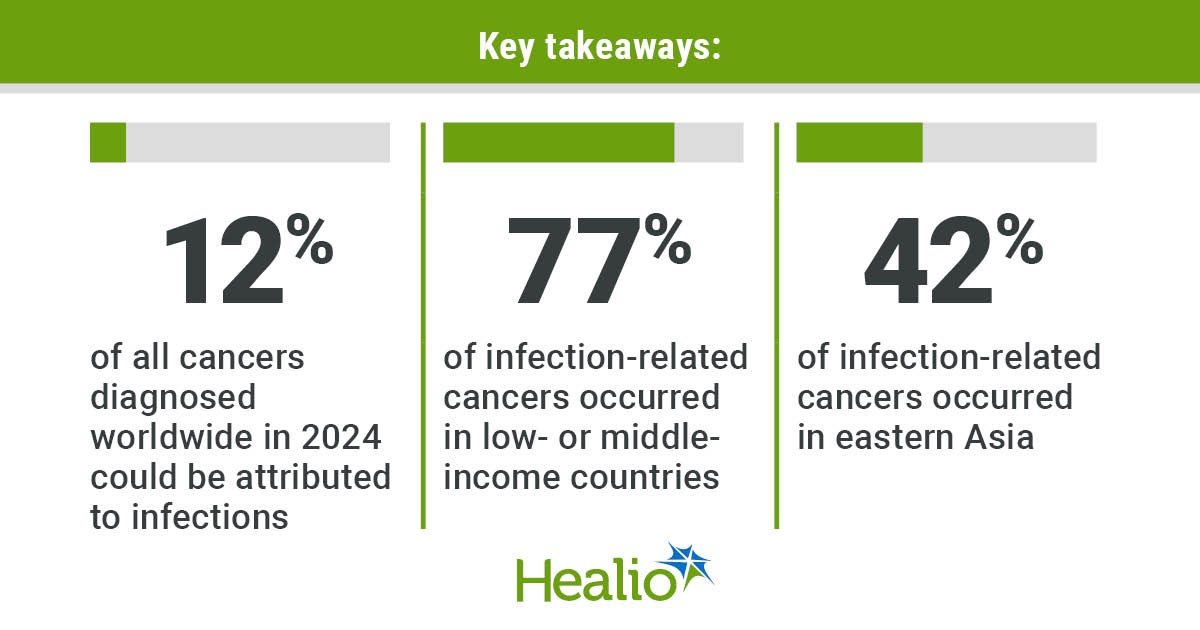
An estimated 2.3 million new cancer cases worldwide in 2024—approximately 12% of all newly diagnosed cancers—were attributable to infections, according to a global analysis led by researchers associated with the International Agency for Research on Cancer (IARC). The findings highlight the substantial contribution of preventable or treatable infections to the global cancer burden and the need to expand access to vaccination, screening, testing, and treatment.
Five infectious agents accounted for most infection-attributable cancers: Helicobacter pylori (760,000 cases), human papillomavirus (HPV; 750,000 cases), hepatitis B virus (HBV; 360,000 cases), Epstein-Barr virus (EBV; 260,000 cases), and hepatitis C virus (HCV; 160,000 cases). Approximately 77% of infection-related cancers occurred in low- and middle-income countries, underscoring persistent disparities in preventive health care.
The investigators emphasized that many of these malignancies could be prevented through established interventions. As lead author Harriet Rumgay, PhD, stated, “While this burden is enormous, it is also largely preventable.” The findings support strengthening existing prevention programs while investing in new strategies, including vaccines against infections such as EBV for which an effective preventive vaccine is not yet available.
Why This Matters
Infections represent a major, potentially modifiable contributor to cancer incidence worldwide. Unlike many established cancer risk factors, several infection-related malignancies can be prevented or reduced through vaccination, antimicrobial treatment, antiviral therapy, and screening.
The findings have three major implications:
- Cancer prevention: Vaccination against HPV and HBV, detection and treatment of H. pylori, and appropriate management of chronic viral infections can reduce the risk of selected malignancies.
- Health equity: The disproportionate burden in low- and middle-income countries highlights the importance of affordable prevention, diagnostic services, and treatment.
- Public health policy: Coordinated vaccination, screening, testing, and treatment programs may prevent substantial numbers of cancers, particularly in regions with high infection prevalence and limited access to health care.
Rumgay described infection-related cancers as “not only a cancer prevention challenge but also a global health equity issue.”
Study at a Glance
| Feature | Details |
|---|---|
| Study type | Global population-based epidemiologic analysis using cancer registry estimates and population-attributable fractions |
| Data source | Global Cancer Observatory’s Cancer Today database |
| Study population | Global population represented in the cancer incidence estimates |
| Study year | 2024 cancer incidence estimates |
| Exposure | Infection with established carcinogenic infectious agents classified by IARC as Group 1 carcinogens |
| Comparator | No randomized or directly assigned comparator; estimates compare attributable and overall cancer burden across infections and geographic regions |
| Primary outcome | Estimated number and proportion of new cancer cases attributable to infections |
| Additional outcomes | Population-attributable fractions (PAFs) and age-standardized incidence rates (ASIRs) |
| Main finding | Approximately 2.3 million new cancers, or 12% of all cases worldwide, were attributable to infections |
| Geographic distribution | Approximately 77% of infection-related cancers occurred in low- and middle-income countries |
| Follow-up | Not applicable as a longitudinal intervention follow-up; the analysis estimated cancer incidence for 2024 |
| Original research DOI | 10.1016/S1470-2045(26)00307-4 |
What the Researchers Found
1. Global burden of infection-related cancers
Researchers estimated that 2.3 million of the 20.6 million new cancer cases reported or estimated worldwide in 2024 were attributable to infections. This represented approximately one in eight new cancers.
Five infectious agents accounted for the largest reported numbers of infection-attributable cases.
| Infectious agent | Estimated attributable cases | Population-attributable fraction (PAF) reported in the article |
|---|---|---|
| Helicobacter pylori | 760,000 | 4% |
| Human papillomavirus (HPV) | 750,000 | 4% |
| Hepatitis B virus (HBV) | 360,000 | 2% |
| Epstein-Barr virus (EBV) | 260,000 | 1% |
| Hepatitis C virus (HCV) | 160,000 | Less than 1% |
Note: Values are reproduced from the supplied article. PAFs are rounded and may not sum to the overall infection-attributable fraction because of rounding, differences in denominators, and the contribution of other infectious agents.
The results identify H. pylori and HPV as the largest contributors among the infections listed, followed by HBV, EBV, and HCV.
2. Age-standardized incidence rates by infectious agent
The overall age-standardized incidence rate for cancers attributable to all included infections was 22.7 cases per 100,000 person-years, according to the article.
| Infectious agent | ASIR (cases per 100,000 person-years) |
|---|---|
| HPV | 7.7 |
| H. pylori | 6.9 |
| HBV | 3.4 |
| EBV | 2.6 |
| HCV | 1.5 |
| Kaposi sarcoma-associated herpesvirus (KSHV) | 0.4 |
| All included infections | 22.7 |
ASIRs account for differences in population age structures, making comparisons between regions or populations more informative than crude incidence rates alone. These rates should not be interpreted as an individual’s personal probability of developing cancer.
3. Geographic distribution of infection-attributable cancers
The burden varied substantially by region. Eastern Asia accounted for 42% of all infection-related cancers worldwide, with approximately 990,000 attributable cases.
| Geographic region | Share or PAF reported | ASIR (cases per 100,000 person-years) |
|---|---|---|
| Eastern Asia | 42% of global infection-related cases; PAF 15% | 31.9 |
| Sub-Saharan Africa | PAF 25% | 28.5 |
| Central and Eastern Europe | PAF 10% | 24.3 |
| Southeastern Asia | PAF 16% | 23.1 |
| South-central Asia | Not specified in the article | 13.3 |
| Western Asia | Not specified in the article | 14.1 |
| Northern Europe | PAF 4% | 14.1 |
| Western Europe | PAF 5% | 15.0 |
| North America | PAF 5% | 15.8 |
| Oceania | PAF 5% | Not specified in the article |
PAF is the proportion of all cancers in a population estimated to be attributable to the specified exposures. ASIR is the age-standardized incidence rate. The article did not provide every regional measure in the supplied text.
Eastern Asia’s large absolute burden was driven largely by H. pylori and HBV. Sub-Saharan Africa had a particularly high attributable fraction, illustrating that the relative contribution of infections to cancer differs by region.
More than three-quarters of infection-related cancers occurred in low- and middle-income countries, emphasizing the importance of access to preventive services and effective treatment.
4. Important infection–cancer associations
| Infectious agent | Principal cancer association highlighted |
|---|---|
| Helicobacter pylori | Gastric cancer |
| HPV | Cervical cancer |
| HBV and HCV | Hepatocellular carcinoma |
| EBV | Nasopharyngeal cancer and lymphoma; additional evidence supports a causal role in gastric cancer |
| KSHV | Kaposi sarcoma and related malignancies |
The authors highlighted EBV as a particularly notable finding. Earlier estimates had not fully incorporated evidence linking EBV to gastric cancer. The inclusion of this evidence increased recognition of the virus’s contribution to the global cancer burden.
5. An updated assessment of infection-related cancer
IARC’s previous global assessment of infection-attributable cancer burden was published in 2018. Since then, evidence has strengthened regarding additional cancer-causing infections and the range of cancers associated with established infectious carcinogens.
The updated analysis incorporated evidence involving HIV and Merkel cell polyomavirus, among other agents, and expanded the assessment of cancer types associated with established carcinogens.
The findings also reinforce the importance of considering infectious exposures alongside other preventable cancer risk factors, including tobacco use.
Clinical Significance
The findings support integrating infection prevention and control into comprehensive cancer prevention strategies.
HPV vaccination and cervical cancer prevention: HPV vaccination reduces the risk of infection with cancer-causing HPV types. Organized cervical screening and appropriate management of precancerous lesions provide additional opportunities to prevent cervical cancer.
HBV vaccination and liver cancer prevention: HBV vaccination can prevent chronic infection and reduce the subsequent risk of HBV-associated liver disease and hepatocellular carcinoma. People with chronic HBV infection may also benefit from appropriate monitoring and antiviral treatment when indicated.
Identification and treatment of H. pylori: Testing and eradication treatment when clinically indicated can reduce infection-related gastric disease and may lower gastric cancer risk. Appropriate testing strategies and follow-up depend on individual clinical circumstances and local guidance.
HCV diagnosis and treatment: Direct-acting antiviral treatment can cure most HCV infections. Identifying and treating infection can reduce liver-related complications, although people with established advanced fibrosis or cirrhosis may continue to require liver cancer surveillance.
EBV and other infection-associated malignancies: The findings support continued research into preventive strategies, including the development of an effective EBV vaccine. At present, an approved preventive EBV vaccine is not available.
The population-level estimates do not establish the benefit of any individual intervention within this study. Rather, they identify where established preventive and therapeutic measures may have the greatest potential public health impact.
Limitations
The supplied article does not provide a complete methods section or the full statistical appendix. The following limitations are therefore relevant considerations for interpreting this type of analysis, rather than a definitive list of limitations explicitly reported by the investigators.
- Observational estimates: Population-attributable fractions are model-based estimates. They do not represent randomized evidence that eliminating a particular infection would immediately prevent every attributed cancer.
- Dependence on source data: The accuracy of estimates depends on the quality and completeness of cancer registration, infection prevalence data, and the evidence linking each infectious agent to specific malignancies.
- Geographic variation in data quality: Cancer diagnosis and registration may be less complete in some low-resource settings, potentially affecting estimates of absolute and relative burden.
- Causal attribution assumptions: PAF estimates depend on assumptions about causal relationships, exposure prevalence, and the counterfactual risk in the absence of exposure.
- Overlapping exposures and outcomes: Some patients may have more than one relevant infectious exposure. Interpretation requires care to avoid assuming that individual agent-specific estimates can simply be added without accounting for overlap and the study’s methodology.
- No individual-level prediction: Global incidence estimates cannot determine an individual’s cancer risk, establish a diagnosis, or identify which preventive intervention is appropriate for a particular patient.
- No intervention comparison: The analysis was not a randomized controlled trial and did not directly compare the effectiveness, safety, or cost-effectiveness of specific vaccination, screening, or treatment programs.
The original publication should be consulted for the investigators’ exact methodological limitations, assumptions, uncertainty estimates, and sensitivity analyses.
What Doctors Should Know
- Prioritize vaccination: Promote HPV vaccination and HBV immunization according to national recommendations and individual eligibility.
- Identify treatable infections: Consider appropriate testing for H. pylori, HBV, and HCV based on clinical indications and local guidelines.
- Use evidence-based screening: Encourage cervical cancer screening and follow established surveillance recommendations for patients at increased risk of liver cancer.
- Treat infections appropriately: Use guideline-concordant eradication therapy for H. pylori and antiviral treatment for eligible patients with chronic viral infections.
- Address disparities: Consider barriers to vaccination, testing, treatment, and follow-up when designing clinical and community prevention strategies.
- Communicate risk accurately: Explain that an infection-associated cancer risk does not mean every infected person will develop cancer. Risk depends on the infectious agent, duration of infection, host factors, and other exposures.
- Avoid overinterpreting population data: The reported attributable cases describe a global public health burden; they are not a direct measure of an individual patient’s risk or the number of cancers that a particular intervention would necessarily prevent.
Bottom Line
Approximately 2.3 million new cancer cases worldwide in 2024—about 12% of all cases—were attributable to infections, with the majority occurring in low- and middle-income countries. H. pylori, HPV, HBV, EBV, and HCV accounted for most of the cases reported in the analysis.
The findings reinforce that infection-related cancer prevention is an achievable public health priority. Expanding access to vaccination, screening, testing, and effective treatment, while improving equity in the delivery of these interventions, could reduce the global burden of several major malignancies.
Original Research
Journal: The Lancet Oncology
Publication date of the news report: September 29, 2026
Original research DOI: 10.1016/S1470-2045(26)00307-4
DOI link: https://doi.org/10.1016/S1470-2045(26)00307-4
Lead author: Harriet Rumgay, PhD
Affiliation reported: International Agency for Research on Cancer (IARC), cancer surveillance branch
Study design: Global epidemiologic analysis of infection-attributable cancer incidence using the Global Cancer Observatory’s Cancer Today database.